Booking for Christmas and New Year: How Far Ahead You Actually Need to Arrange Entry Approval
 Elena DarziOctober 19, 202629 min read
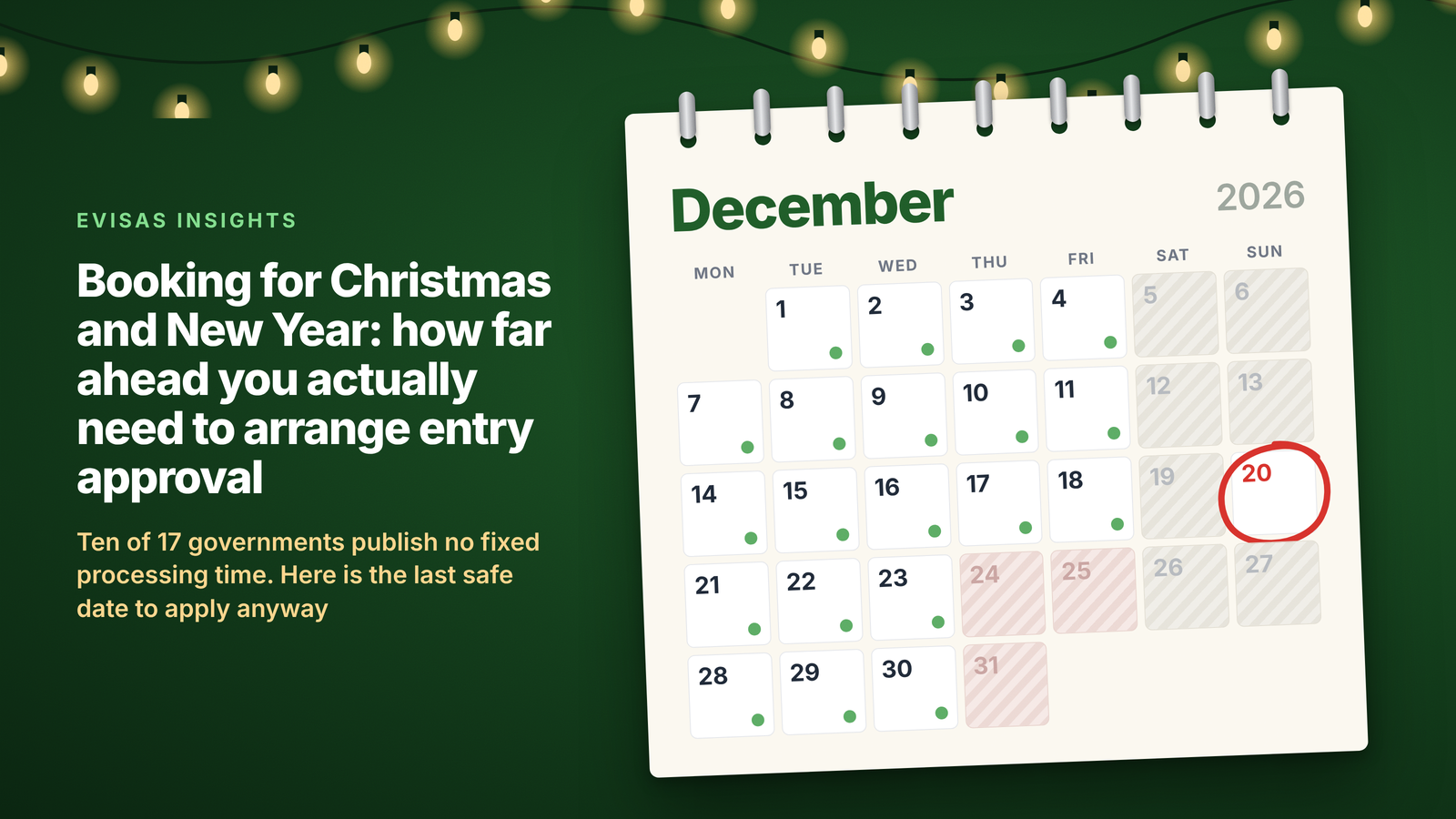
Ten of 17 governments publish no fixed processing time. We worked out the last safe date to apply anyway.
We read the official pages of 17 governments that issue the visas, eTAs and travel authorisations people most often need for Christmas and New Year trips. Ten of them do not give a fixed figure for how long a decision takes. Five of those ten give an instruction instead, such as “at the time you book your travel” or “at least 7 days before departure”. The other five publish neither a processing time nor a lead-time instruction on their official portals.
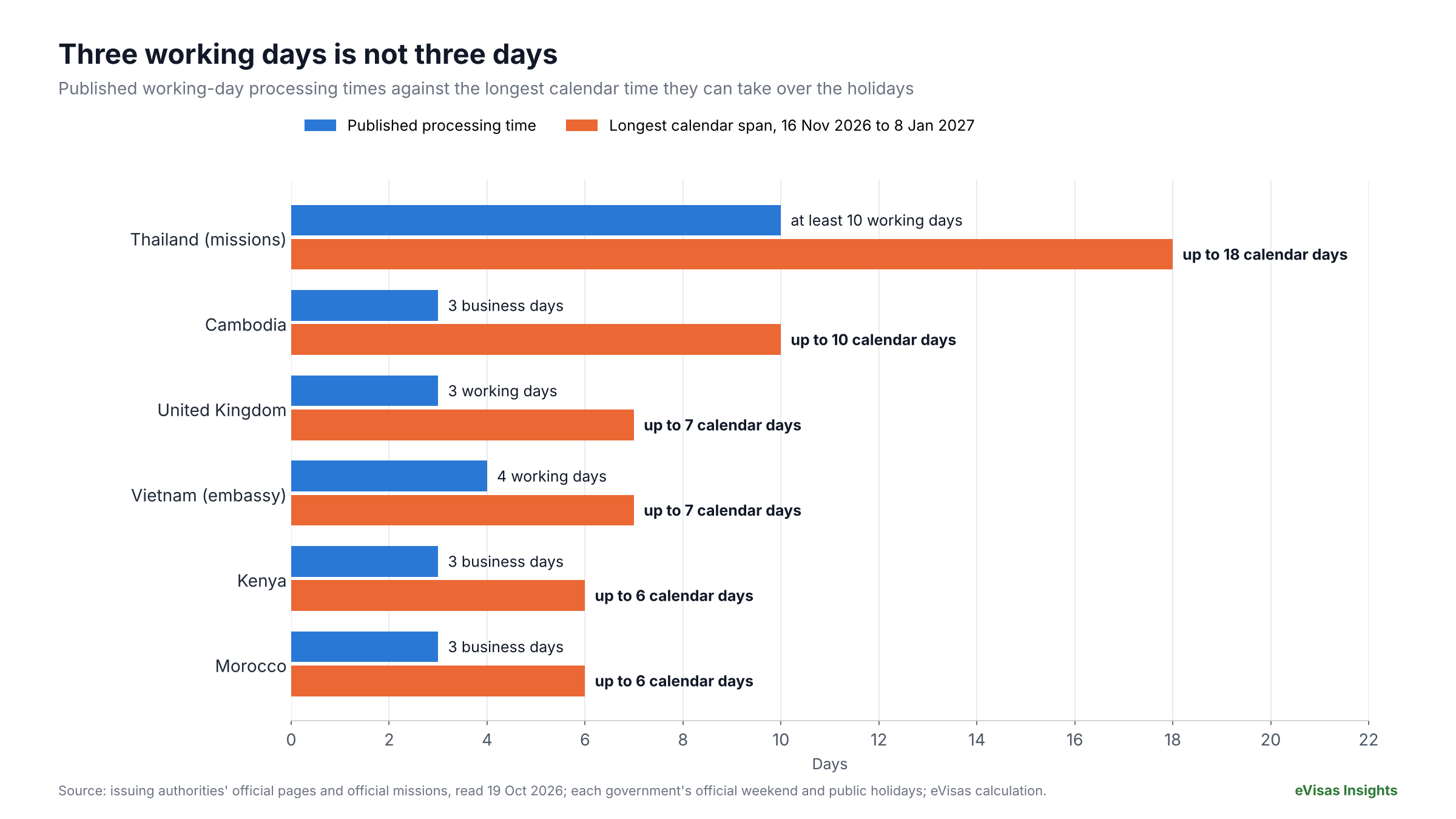
The seven that do publish a figure mostly count it in working days, and working days are scarce in December. Over the holidays, a published three working days can take a week of calendar time, and in Cambodia over November’s Water Festival, ten days. Thailand’s missions quote at least five to ten working days, and ten working days can stretch to 18 calendar days across the New Year.
So we did the arithmetic. For a departure on Sunday 20 December 2026, the last safe date to start falls in November, or before you even book, for ten of the 17 destinations, on official advice or, where no time is published, on our 30-day planning standard. The first November date is Friday 20 November. This article gives that date for every destination, shows the reasoning, and explains what to do if you have already missed it.
The short answer
For a departure on 20 December 2026:
United States, Canada and Australia:
apply before you book flights. Each authority says so in its own words.
Thailand, Saudi Arabia, Egypt, India, Sri Lanka, Tanzania and Turkey:
start by Friday 20 November.
Kenya:
start by Sunday 6 December (in practice, Friday 4 December), in line with the two-week advice the UK government attributes to Kenya’s authorities.
Vietnam:
start by Tuesday 8 December.
United Kingdom, Cambodia and Morocco:
start by Thursday 10 December.
New Zealand:
start by Sunday 13 December.
United Arab Emirates:
start by Tuesday 15 December.
For a New Year departure on Wednesday 30 December, most dates move seven to eleven days later. The full table, including the latest date that still works if nothing goes wrong, is below.
The countdown table
Two dates are given for each destination. The latest start is the last day an application can go in and still be decided before the day of departure, if it is complete, correct and decided within the authority’s own published time or, for Thailand, its missions’ advance advice. The safe start leaves room for one thing to go wrong: a rejected photo, a typing error in a passport number, a request for another document. It allows a second full processing cycle, or follows the authority’s own advance advice where that is longer. Where an authority publishes no time at all, we use a 30-day planning standard, explained in the methodology.
Table 1. When to start, for departures on 20 and 30 December 2026
Source: each issuing authority’s official page, read 19 October 2026; Thailand, Vietnam’s fourth-day figure, Kenya’s two-week advice and Cambodia’s four-day advice are from official missions or the UK FCDO, as marked in the dataset. Working days are counted in the issuing country, excluding its weekend and its official public holidays. Dates are eVisas calculations. Download the full dataset: christmas-entry-approval-lead-times-2026.csv (CC BY 4.0).
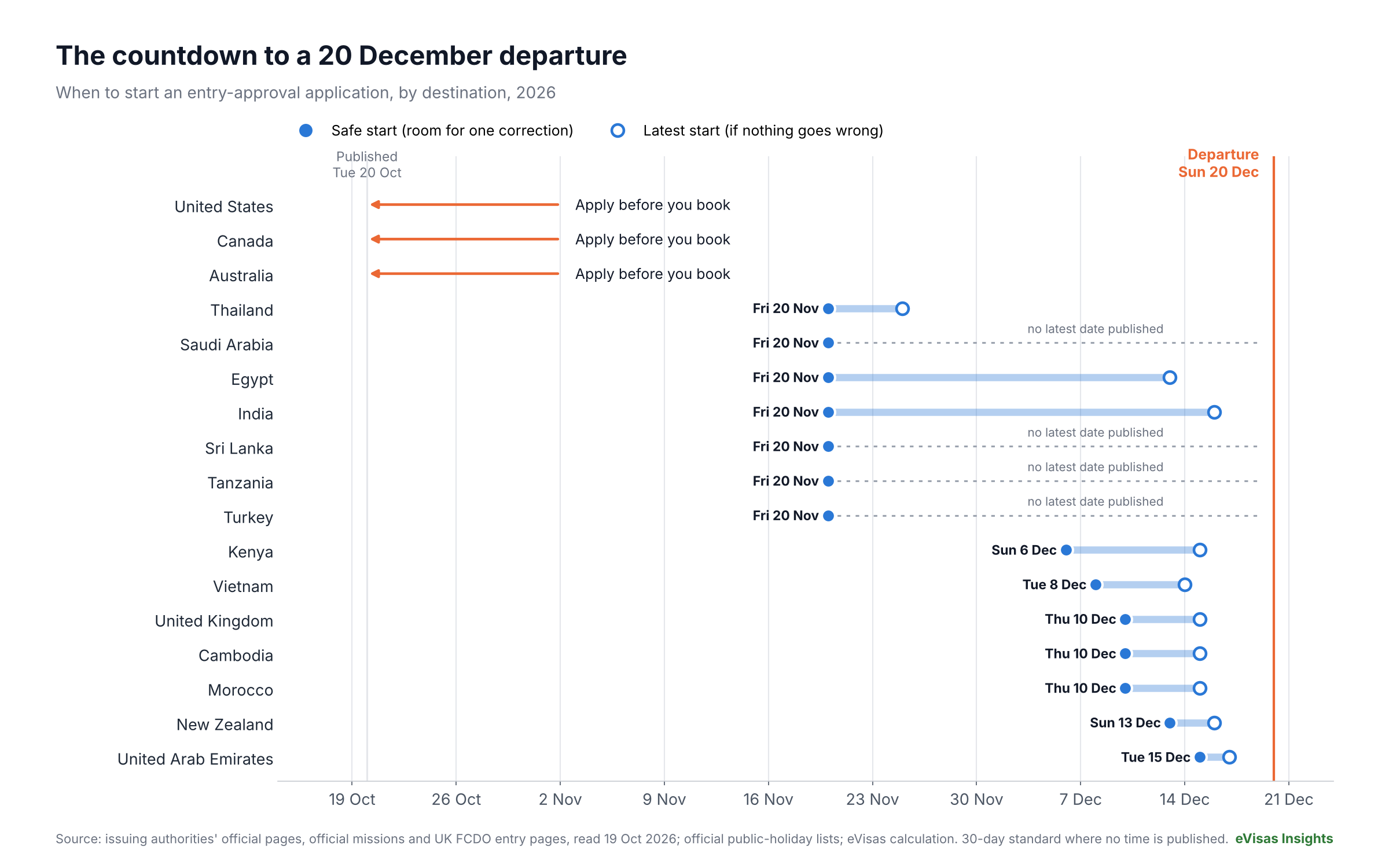
Interactive calculator (web team: embed Charts/christmas-lead-time-calculator.html here). Travelling on a different date? Pick your destination and departure date to see your own safe and latest start dates.
If your destination is in the top half of that table, the date that matters is in November or earlier. Check the current turnaround for your destination before you book anything else.
What 17 authorities actually publish
Almost every traveller asks the same question first: how long does it take? Most governments do not answer it.
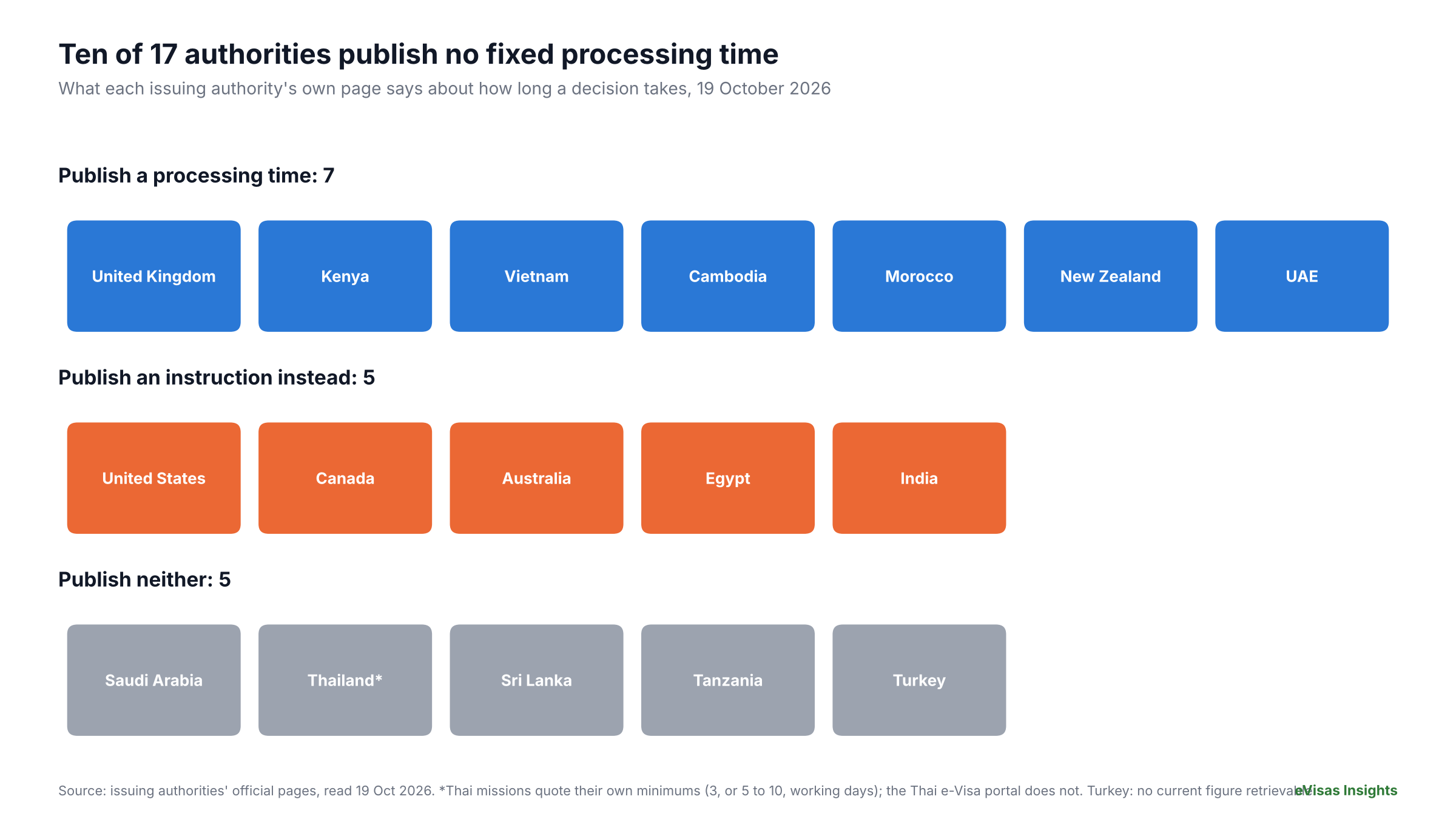
Seven publish a number. The United Kingdom says a decision “can take up to 3 working days”. Kenya says applications “are generally processed within three (3) business days/72 hours but may take longer depending on the verification processes”. Vietnam’s Ministry of Public Security sets “03 working days from the date of receiving application”; its embassy in Australia says applicants “normally receive e-visas at the end of the fourth working day”. Cambodia’s portal states “3 business days”, Morocco’s “3 Business Day(s)”. New Zealand says “Allow 72 hours”, and Dubai’s immigration authority gives an “Expected Completion Time” of 48 hours.
Five publish an instruction instead. The United States Department of Homeland Security recommends that ESTA applications “be submitted when travel plans are made”. Canada says to apply for an eTA “before you book your travel”. Australia tells ETA applicants not to “make travel arrangements until your ETA has been granted”. Egypt says “You have to create an e-Visa application at least 7 days before your departure”. India says e-Tourist Visa applicants “may apply online minimum 4 days in advance of the date of arrival”.
Five publish neither. The official portals for Saudi Arabia, Sri Lanka, Tanzania and Thailand state no processing time for the online product, and Turkey’s current figure could not be retrieved from its portal. (Australia’s eVisitor page also points to a guide to recent processing times rather than stating one.) Thailand’s embassies fill the gap themselves, and they do not agree: the Royal Thai Embassy in Kuwait says “minimum processing time: 3 working days”, while the embassy in Bucharest says at least 5 to 10 working days and asks travellers to apply 30 days ahead for travel between November and February.
The second finding sits inside the first. Where official advice on when to apply exists alongside a processing time, it is often longer. Kenya’s eTA portal says three business days; the advice the UK government attributes to Kenya’s authorities is two weeks. Vietnam’s procedure page says three working days; its embassy in Australia says to apply “months before” travel. Cambodia’s portal says three business days; the UK FCDO advises applying at least four days ahead. Thailand’s missions quote minimums of 3, and of 5 to 10, working days; Bucharest recommends 15 working days, or 30 days in the peak season, and Kuwait 10 working days. A processing time describes the system when everything works.
Why three working days is not three days
Most published times are counted in working days, and the working days are the issuing country’s, not yours. December removes a lot of them.
Three examples show how it happens.
Cambodia, late November. Sub-Decree 167 sets the Water Festival holiday from Monday 23 to Wednesday 25 November 2026. An application submitted on Friday 20 November has its three business days on 26, 27 and 30 November. Three business days become ten calendar days.
United Kingdom, Christmas week. Christmas Day is Friday 25 December, Boxing Day is moved to Monday 28 December, and New Year’s Day is Friday 1 January. An ETA application made on Tuesday 22 December has its three working days on 23, 24 and 29 December. Three working days become seven calendar days.
Thailand, the peak season. Thailand’s government holidays in the window include Monday 7 December (moved from Saturday 5 December), Thursday 10 December, Thursday 31 December and Friday 1 January. Ten working days can stretch to 18 calendar days, and an application made on Thursday 24 December would, on that count, not be decided until Monday 11 January.
Other holidays sit inside the countdown window too: Morocco’s Independence Day (Wednesday 18 November), Sri Lanka’s Poya days (Tuesday 24 November and Wednesday 23 December), India’s Guru Nanak Jayanti (Tuesday 24 November), the UAE’s National Day (Wednesday 2 and Thursday 3 December), Tanzania’s Independence Day (Wednesday 9 December) and Cambodia’s Peace Day (Tuesday 29 December). Some do not affect the dates in Table 1, but all of them close offices that answer queries.
Weekends differ as well. Most of these governments work Monday to Friday. Morocco’s portal defines its business days in exactly those terms, “Monday to Friday”, excluding public holidays. Not every issuing country keeps the same weekend, which is one more reason to count in the destination’s calendar rather than your own.
How to read a published processing time
Four rules turn an official figure into a date you can rely on.
1. Plan on the upper limit, not the typical case. Where an authority gives a range or a qualifier, such as “up to 3 working days” or “may take longer”, the date that matters is the end of the range. Where a figure is published, every date in Table 1 is built on the longest one, from the authority or its official missions.
2. Find out when the clock starts. The UAE’s 48 hours run “after fulfilling all requirements”. Vietnam’s three working days run “from the date of receiving application for electronic visa and visa fee”. An application that is missing a document, or whose payment has not cleared, has not started.
3. Treat referral as a real possibility. Kenya says processing “may take longer depending on the verification processes”. New Zealand says “It may take longer if we need to investigate further”. Canada says applicants may need to submit documents before an application can be approved. Thailand’s portal says the embassy “may request for an interview or additional documents”. They are part of the published process.
4. A correction restarts the count. If an application is refused because of a mismatched passport number or an unusable photo, the second application starts from zero. Vietnam’s embassy asks applicants to “allow 4 more working days” for a correction. That is why our safe start date allows a second cycle.
Your destination, by urgency
Apply before you book: the United States, Canada and Australia
Three governments answer the timing question with an instruction rather than a number, and the instruction is the same: do it first. The ESTA FAQ says “CBP recommends that you apply for ESTA at the time you book your travel”. Canada says to apply “before you book your travel to Canada”. Australia’s Department of Home Affairs says “We suggest you do not make travel arrangements until your ETA has been granted”, and for the eVisitor, “Do not arrange to travel to Australia until we let you know in writing that we have granted you the visa.”
The reason is practical. Each of these authorisations can come back as pending: ESTA’s own wording is “Your travel authorization is under review because an immediate determination could not be made”. Canada says “up to several days”. Without the authorisation you cannot board: Canada says “you won’t be able to board your flight”, and ESTA is required “prior to being granted boarding”. If you have already booked, apply today. Check the United States, Canada or Australia page for what the application needs.
Start by Friday 20 November: Thailand, Saudi Arabia, Egypt, India, Sri Lanka, Tanzania and Turkey
Thailand is the one destination in this group where an official source names the season. The Royal Thai Embassy in Bucharest asks e-Visa applicants to apply at least 15 working days ahead, and 30 days ahead for travel between November and February; it also warns that delays can come from “incomplete documents, system errors, public holidays”. The Thai e-Visa portal states that “the Royal Thai Embassy or Consulate-General may request for an interview or additional documents”. Advice differs between missions, so check the page of the mission that will handle your application. If you need a Thai visa for a December trip, start your Thailand application by 20 November.
Saudi Arabia, Sri Lanka, Tanzania and Turkey publish no processing time that we could retrieve. Saudi Arabia’s terms say approval is “at the sole discretion” of the Ministry of Tourism and that “Holding an eVisa does not guarantee entry”. Tanzania’s portal says applicants “may as well be required to visit the nearest Tanzanian Embassies or Consular Offices for interviews”, and its embassy in the United States advises that some applicants should not book flights until they hold the visa. Sri Lanka’s portal says only that a traveller “needs to apply and obtain an ETA prior to arrival”. With no published figure, there is no official date to work back from, which is a reason to start early rather than late. Start on the Saudi Arabia, Sri Lanka, Tanzania or Turkey page.
Egypt and India publish a minimum lead time rather than a processing time. Egypt’s is at least 7 days before departure; India’s is at least 4 days before arrival, counted in calendar days. A minimum is a floor, not a forecast. Applying on the minimum leaves no time for a correction, and neither portal says how long a decision takes. India also requires that the status shows as “GRANTED” before the journey begins. Start your Egypt or India application by 20 November for a 20 December departure.
Start in the first ten days of December: Kenya, Vietnam, the United Kingdom, Cambodia and Morocco
Kenya is the clearest case of an official processing time and official advice pointing to different dates. The eTA portal gives three business days; the UK government’s travel advice, updated on 16 October 2026, says “The local authorities recommend applying at least 2 weeks before your departure”. The same page notes a change this season: since 5 October 2026, travellers buy Kenyan government travel health insurance as part of the eTA application. The portal is explicit that “You are only allowed to travel after your application has been approved by the Government of Kenya.” Start the Kenya eTA by Sunday 6 December.
Vietnam’s safe start is Tuesday 8 December, two cycles of the embassy’s four working days. The United Kingdom’s is Thursday 10 December: the Home Office says “You must wait until you get an email confirming you have an ETA before you travel to the UK”, and since 25 February 2026 airlines have been refusing boarding to passengers who need an ETA and do not have one. Every traveller needs their own ETA, “including babies and children”, and the Home Office warns that people who apply together “may get decisions at different times”. Cambodia’s and Morocco’s safe starts are also Thursday 10 December. Cambodia’s late-November Water Festival does not affect a December departure, but its Peace Day on 29 December does affect New Year trips. Start on the Vietnam, United Kingdom, Cambodia or Morocco page.
Mid-December: New Zealand and the United Arab Emirates
New Zealand counts in hours: “Allow 72 hours”, with the warning that it “may take longer if we need to investigate further”. The safe start for 20 December is Sunday 13 December. The NZeTA must match the passport you travel on: “If your passport details are not correct you may not be able to board your plane or cruise ship.”
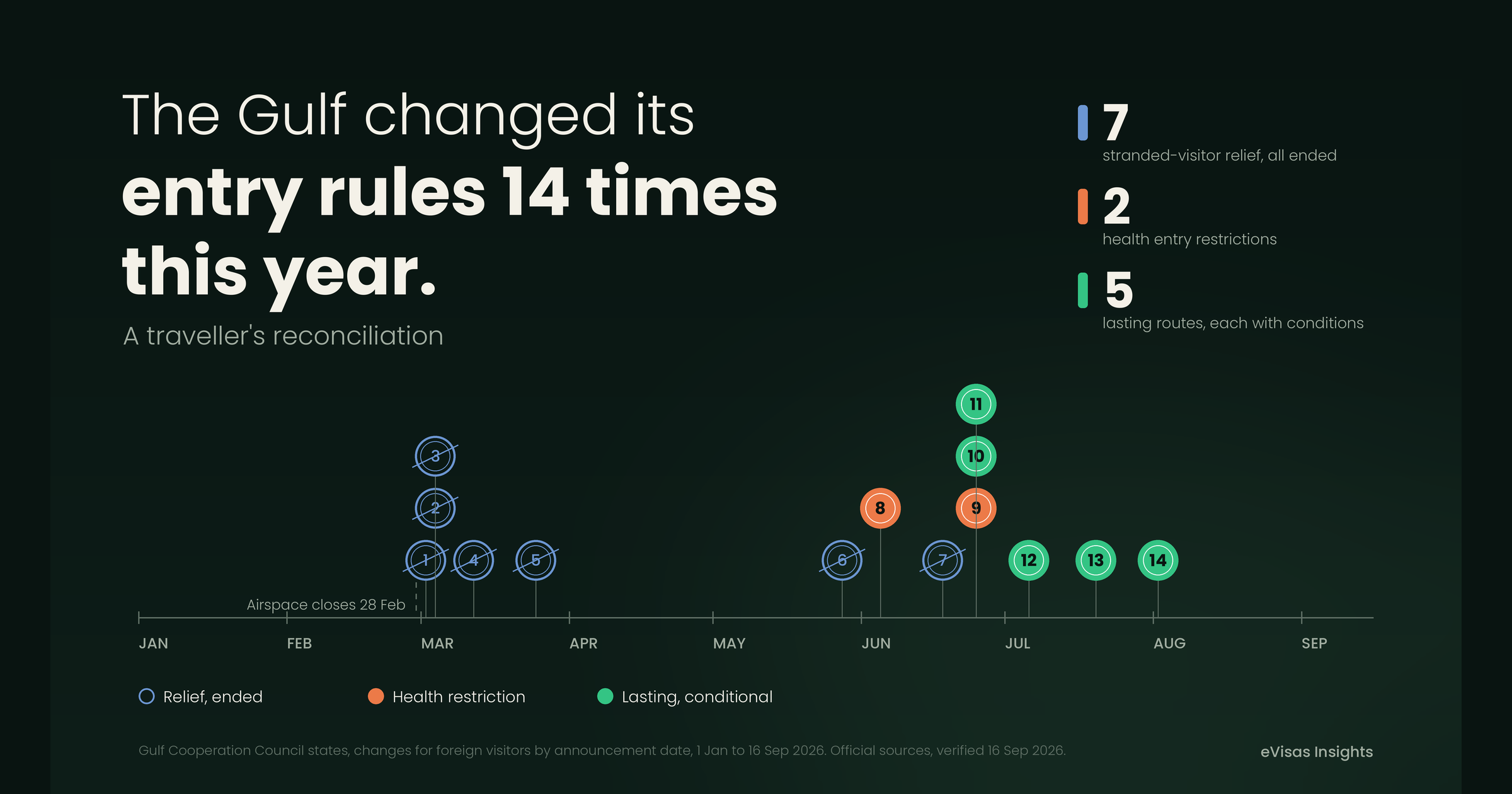
The United Arab Emirates gives 48 hours, but only “after fulfilling all requirements”, and tourist visas are submitted through licensed tourism establishments rather than by the traveller alone. The safe start for 20 December is Tuesday 15 December. Both dates are late only in comparison with the rest of this list; a single missing document moves them earlier. See the New Zealand and United Arab Emirates pages. For the wider changes to Gulf entry rules this year, see The Gulf Changed Its Entry Rules 14 Times This Year.
Already hold one? Check it before you rely on it
Several of these authorisations last for years, so many travellers will assume they are covered. Check two things.
Is it linked to the passport you will carry? The UK ETA, ESTA, Canada’s eTA and Australia’s ETA are all tied to the passport used to apply. Canada: “If you get a new passport, you need to get a new eTA.” ESTA: travellers who obtain a new passport “must submit a new travel authorization application”. Australia: if the passport expires or is replaced, “your ETA will cease”. The UK ETA “lasts for 2 years or until your passport expires, whichever is sooner”. If you renewed your passport this year, the authorisation from your last trip does not carry over.
Does the validity run from the date of issue? For some products it does, which matters if you apply very early or hold an older approval. Cambodia’s e-Visa is valid for “3 months (starting from the date of issue)”. Sri Lanka’s ETA must be used to enter “within three months from the date of issue”. Saudi Arabia’s tourist eVisa “will be valid for one year from the date of issuance”. India’s one-year and five-year e-Tourist Visas run from the date of grant. For a December trip, none of these rules is a reason to wait: an application made now leaves enough validity on every one of them.
What happens if you are late
The honest answer is that you may not travel on the day you booked. The UK ETA, ESTA and Canada’s eTA are checked before boarding. Kenya says you may travel only after approval, and India asks travellers to confirm the status is “GRANTED” before the journey starts. New Zealand says it can stop a passenger at check-in, and Australia tells travellers not to make arrangements until the ETA is granted.
If your safe start date has passed but the latest start date has not, apply immediately and make sure the application is complete the first time, because there is no longer room for a second attempt. If the latest date has also passed, look at whether your flight can be moved, and check the airline’s change rules before the day rather than at the airport. Keep checking the authority’s own status page rather than waiting for an email that may be in a spam folder; the UK Home Office specifically tells applicants to “check your spam or junk email folder” before contacting it.
Travelling to Europe this Christmas
The EU’s Entry/Exit System, which registers non-EU travellers’ biometrics at the Schengen border, has been “fully operational across all Schengen countries since 10 April 2026”, according to the European Commission. ETIAS, the EU’s planned travel authorisation, is a separate system. The Commission’s April 2026 guidance said ETIAS “is scheduled to start in the last quarter of 2026” and that the exact start date would be communicated later. As of 19 October 2026 we found no official announcement of a start date. Check the EU’s official travel website before you go.
Where eVisas fits
The research in this article points to one practical problem: for most destinations, the date that decides whether you travel is set by something nobody publishes, and an application that has to be done twice is one avoidable way to miss it.
That is the part we can help with. On eVisas, every application for Thailand, Kenya, India, Egypt, the United Kingdom and the other destinations in this table is checked for completeness and accuracy before it is submitted, which is where avoidable refusals and resubmissions often start: a passport number that does not match, a photo that fails the specification, a missing document. We track each application’s status and keep you updated until a decision is issued, and our support team answers questions in the meantime. Each destination on our destinations page shows the date by which we currently expect a decision. For the UAE, we are partnered with South Travels DMCC, a licensed tourism establishment.
We cannot make a government decide faster, and we cannot guarantee an outcome; no one can. What we can do is help you submit once, correctly, before the date that matters.
Methodology and limitations
Scope. Seventeen destinations: the twelve the editorial brief identified as carrying December demand (UAE, Saudi Arabia, Egypt, Morocco, Turkey, Sri Lanka, Thailand, Vietnam, Cambodia, India, Kenya, Tanzania) plus the five long-haul travel authorisations most used for Christmas trips (United Kingdom, United States, Canada, Australia and New Zealand). We looked only at the tourist eVisa, eTA or travel authorisation for each.
Sources. Every processing time, instruction and rule was read on the issuing authority’s own page on 19 October 2026. Where the portal was silent or unreachable, we used an official mission of that country or the UK Foreign, Commonwealth and Development Office’s entry requirement pages, and say so. Public holidays come from each government’s own holiday list, statute or gazette; where a 2026 list was not yet published, we applied the statutory rule and say so in the dataset. No visa agency, news report or encyclopedia was used as a source.
Calculation. For working-day figures, we counted forward from a submission date across the issuing country’s weekdays, skipping its official public holidays, and required the decision by the day before departure. The latest start is the last submission date that meets that requirement once. The safe start meets it twice (two full cycles), or follows the authority’s own advance advice where that is earlier. Figures stated in hours were converted to whole days, plus one day, so that the decision arrives the day before departure. Where an authority publishes a minimum lead time (Egypt, India), that minimum is the latest start; India’s is counted from arrival, and we count it from departure to be safe. Thailand’s portal publishes no time, so for Thailand we used the Royal Thai Embassy in Bucharest’s advice: 15 working days for the latest start and 30 days for the safe start. Where an authority publishes no time, we use a planning standard of 30 days before departure. That is an eVisas standard, not an official figure. We chose it because it matches the longest numeric advance-application advice found in this research (the Royal Thai Embassy in Bucharest, for November to February travel).
Limitations. Published times describe the authority’s service standard, not a measured outcome; no authority in this set publishes observed decision times for December. Advice from missions can differ within one country, as Thailand’s does. Holiday dates for early January 2027 were not yet officially published in Egypt, Vietnam and Cambodia. Kenya may still gazette substitute holidays for 12 and 26 December, and Thailand’s Constitution Day is absent from one official list; both are flagged in the dataset. Time zones are ignored; a submission late in the evening in one country may land on the next working day in another. The dates in this article apply to departures on 20 and 30 December 2026 and are not valid for other dates or other years; use the calculator for other dates.
Review. Every figure will be rechecked on 17 November 2026, before the first safe date of 20 November, and the article will be refreshed for the 2027 season.
Frequently asked questions
How long does a visa take to process for Christmas travel?
It depends on the destination, and ten of the 17 authorities we checked publish no fixed processing time. Of those that do, most quote three or four working days, but working days are scarce in December: three working days can take seven calendar days over Christmas in the United Kingdom, and ten working days can take 18 calendar days in Thailand over the New Year.
When should I apply for a visa for a 20 December trip?
For the United States, Canada and Australia, apply before you book. For Thailand, Saudi Arabia, Egypt, India, Sri Lanka, Tanzania and Turkey, start by Friday 20 November. For Kenya, by Sunday 6 December (in practice, Friday 4 December); for Vietnam, by Tuesday 8 December; for the United Kingdom, Cambodia and Morocco, by Thursday 10 December; for New Zealand, by Sunday 13 December; and for the UAE, by Tuesday 15 December.
What is the difference between working days and calendar days?
Working days exclude the issuing country’s weekend and its official public holidays; calendar days count every day. A processing time of three working days submitted just before a weekend and a public holiday can take a week or more in calendar time. Count in the destination’s calendar, not your own.
Is it too late to apply for a visa for New Year?
Not yet for most destinations. For a departure on Wednesday 30 December, the safe start dates run from Monday 30 November (Thailand and the destinations that publish no fixed processing time) to Friday 25 December (the UAE). For the United States, Canada and Australia, the official advice is to apply before you book.
Can I travel if my ESTA, eTA or ETA is still pending?
No. ESTA is required “prior to being granted boarding”, Canada says without an eTA “you won’t be able to board your flight”, and the UK says “You must wait until you get an email confirming you have an ETA before you travel to the UK.” Kenya says you may travel only after approval.
Do I need a new ETA or eTA if I renewed my passport?
For the UK ETA, US ESTA, Canada eTA and Australia ETA, yes. Each is linked to the passport used to apply, and the authorities state that a new passport needs a new authorisation (in the UK’s case, the ETA lasts until the passport it is linked to expires).
Is ETIAS needed for Europe this Christmas?
As of 19 October 2026, ETIAS had not started and no start date had been officially announced. The European Commission has said the exact start date will be communicated later. The Entry/Exit System, which records biometrics at the Schengen border, has been fully operational since 10 April 2026.
Conclusion
The question travellers ask, “how long does it take?”, turns out to be the wrong one for December. Most governments do not answer it, and those that do answer it in working days that the holidays quietly remove. The useful question is “when is the last day I can start, and still have room to fix a mistake?” For ten of the 17 destinations here, on official advice or our 30-day planning standard, that day falls in November or comes before you book. The first November date is Friday 20 November.
Find your destination in the table, put the safe start date in your calendar, and treat it as the deadline, not the latest start date.