Ireland Scraps the Right to Appeal Most Short-Stay Visa Refusals
 Elena DarziSeptember 16, 20262 min read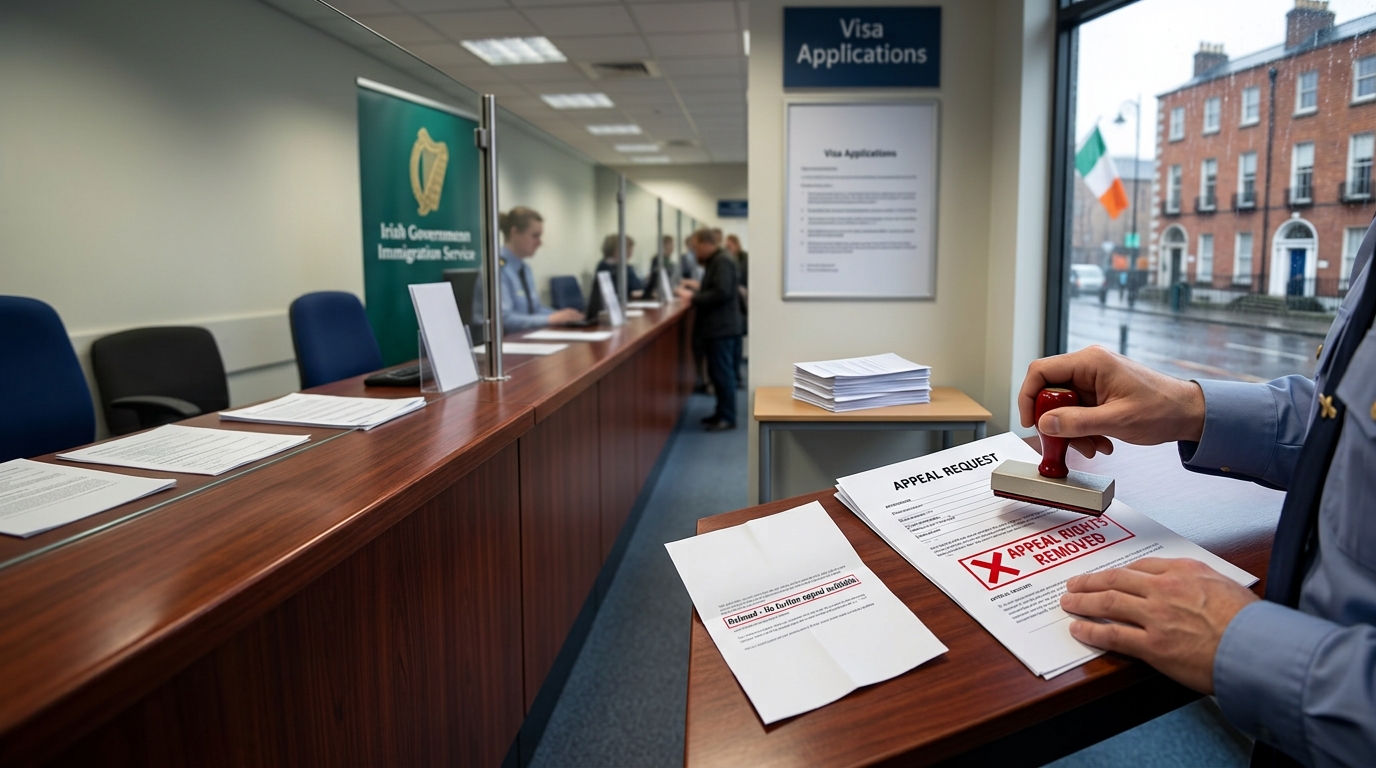
Ireland has removed the right to appeal refusals of short-stay visas. The change, made by the Department of Justice, Home Affairs and Migration, took effect on 1 June 2026.
What exactly changed
Applicants refused a short-stay Type C visa can no longer appeal that decision. The refusal stands.
There is one exception: applicants under the EU Free Movement Directive retain their appeal rights.
Long-stay Type D visas are unaffected. Appeal rights for those applications continue as before.
The reasoning
Minister Colm Brophy explained the change in terms of timing rather than principle. Short-stay trips (holidays, family visits, weddings, conferences, events) lose their purpose by the time an appeal is decided.
The argument is that an appeals process which delivers a reversal after the wedding has happened is not a remedy in any useful sense. Refused applicants are instead encouraged to submit a fresh application.
What this means for applicants
The first application is now the only application that matters within a given timeframe.
A refusal does not permanently bar you; you can apply again. But a fresh application means starting over, with a new decision timeline, and the trip you were planning may well be over before the second decision arrives.
There is also a practical consequence people underestimate: a refusal on your record is something you will be asked to disclose in future applications, to Ireland and often to other countries. A refusal that could previously have been overturned on appeal now stays a refusal.
How much extra time should I allow?
Enough that a refusal and a resubmission still leave you able to travel.
That is a different calculation from the one most people make. The usual approach is to allow for the stated processing time plus a margin. The right approach now is to allow for the full cycle twice, if the trip is one you cannot move.
For anything with a fixed date (a wedding, a graduation, a conference), that argues for applying considerably earlier than the guidance suggests.
Where refusals actually come from
Short-stay visa refusals across Europe are dominated by a small number of recurring problems: insufficient evidence of the purpose of the visit, insufficient evidence of means, insufficient evidence of ties to the home country, and inconsistencies between the application and the supporting documents.
These are documentation problems rather than eligibility problems. An applicant who is genuinely eligible can be refused because the file did not demonstrate it.
That has always been true. What has changed is that there is now no second look.
The takeaway
When there is no appeal, everything rests on the completeness and internal consistency of the first submission. Ireland has effectively raised the cost of a preventable error from a delay to a lost trip.
Verified against the announcement by the Department of Justice, Home Affairs and Migration, effective 1 June 2026.