The Philippines Opened Up to Chinese and Indian Travellers, With Airport and Duration Limits
 Omar Al-FarouqiSeptember 21, 20263 min read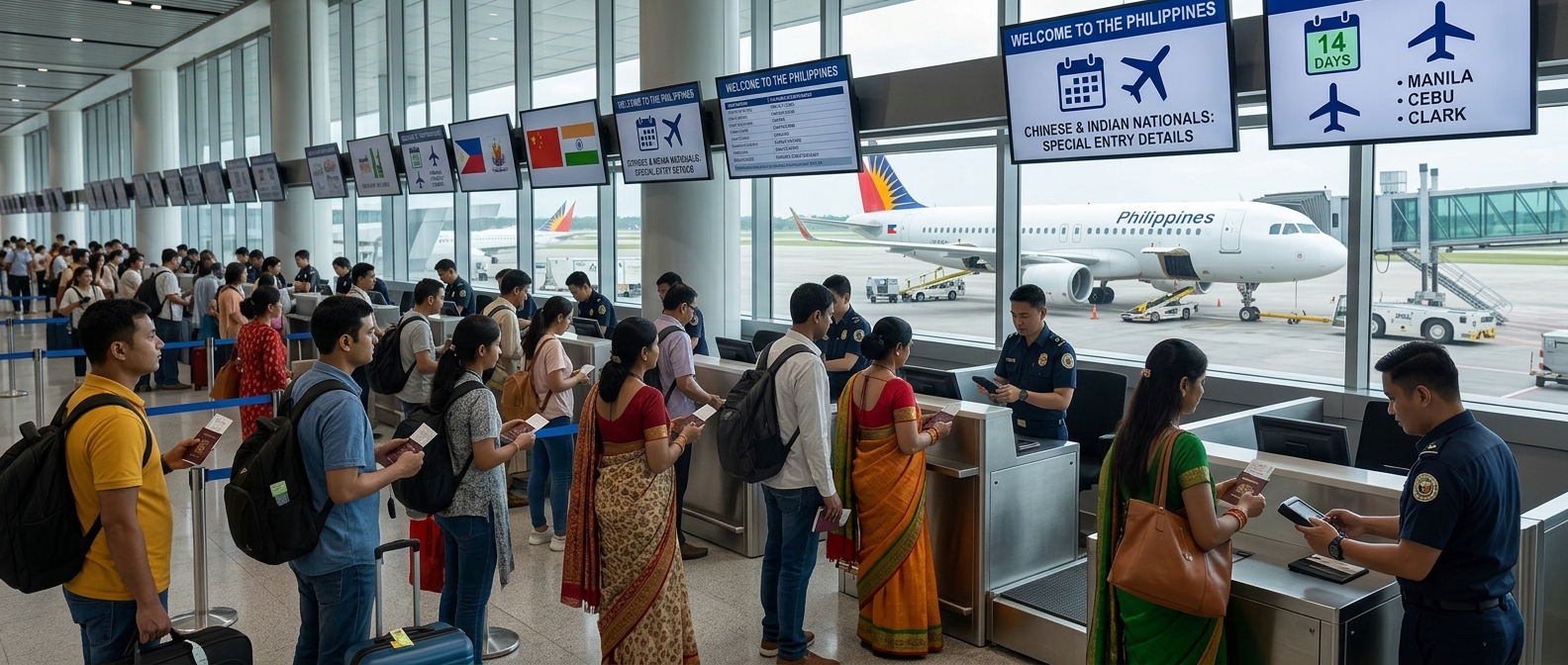
The Philippines now allows visa-free entry for Chinese and Indian nationals. Both arrangements come with conditions that determine whether the trip you are planning actually works.
Chinese passport holders
Effective 16 January 2026, holders of Chinese passports may enter the Philippines visa-free for 14 days for tourism or business.
The condition is the one that catches people. Entry is permitted only through two airports: Ninoy Aquino International Airport in Manila, and Mactan-Cebu International Airport.
Arriving anywhere else does not qualify. A traveller booking into Clark, Davao, Kalibo or Puerto Princesa is not covered by the arrangement, regardless of nationality or intention.
Because airlines check entry eligibility against the route being flown, this is not a problem discovered at Philippine immigration. It is a problem discovered at check-in, before departure.
Indian passport holders
Indian nationals may enter visa-free for 14 days, an arrangement in place since 8 June 2025, subject to holding a valid passport, a hotel booking and a return ticket.
There is an upgrade. Indian nationals holding a valid visa for Australia, Japan, the United States, Canada, the Schengen area or the United Kingdom qualify for 30 days rather than 14.
That distinction is worth checking before you compress an itinerary. A traveller who holds a current US or Schengen visa has more than twice the time available, and many do without realising it applies here.
What 14 days actually buys you
Less than most people plan for. The Philippines is an archipelago, and internal travel consumes days. An itinerary taking in Manila, Palawan and Cebu is tight inside two weeks once transfers are counted.
Travellers who habitually plan three-week Southeast Asian trips should check the arrangement against the actual dates rather than assuming a month is available.
Do the documentary conditions get checked?
The hotel booking and return ticket requirements for Indian nationals are stated conditions of the arrangement, not suggestions. Travellers should expect to be able to produce both, at check-in and on arrival.
Visa-free is not guaranteed entry
As always, entering without a visa means you may travel to the border and be assessed. The immigration officer makes the admission decision.
The wider context
Both measures are part of a broader regional pattern of easing access for large Asian source markets. Several Southeast Asian countries have moved the same way over the past two years, though each with its own conditions, durations and exclusions.
The practical lesson for anyone planning a multi-country trip through the region is that the rules do not carry across borders. Being visa-free for the Philippines tells you nothing about Vietnam, Thailand, Cambodia, Malaysia or Singapore, each of which has its own arrangement for the same passport.
What to do
If you hold a Chinese passport, book your inbound flight into Manila or Cebu specifically, and confirm the arrival airport before paying for anything non-refundable.
If you hold an Indian passport, check whether you hold a qualifying visa for one of the six listed jurisdictions; it may double your permitted stay.
For either, count the days against your real itinerary, and check the arrangements for each additional country separately.
Verified against the official Philippines eVisa policy page maintained by the Bureau of Immigration and the Department of Foreign Affairs.