Passport Stamps Are Gone: Inside the EU Entry/Exit System Six Months On
 Amina KhalidiAugust 24, 20264 min read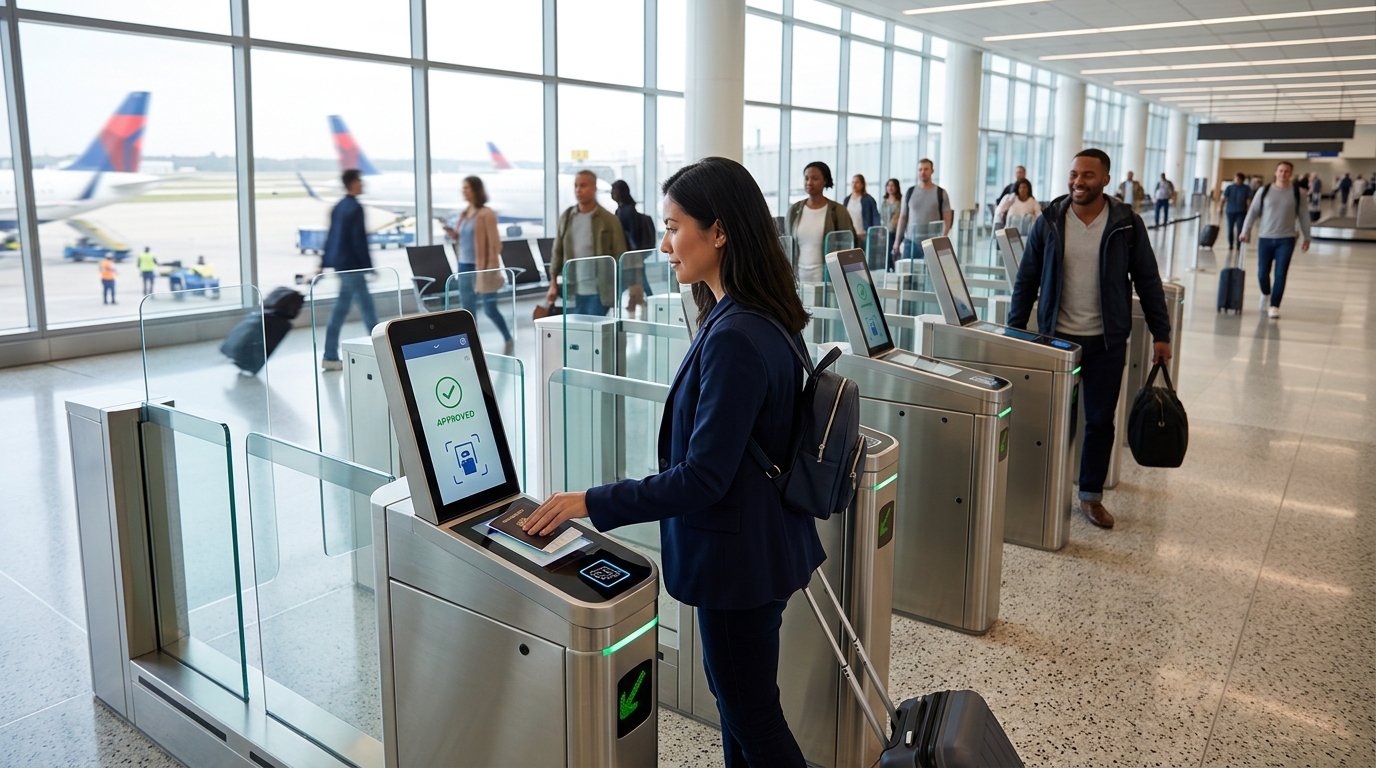
For decades, the proof that you entered Europe was an ink stamp in your passport. That era ended on 10 April 2026, when the European Union's Entry/Exit System became fully operational across all 29 Schengen countries.
Six months in, there is enough official data to say what actually changed, and what travellers keep getting wrong about it.
What EES is
EES is a digital record of every crossing of a Schengen external border by a non-EU national travelling for a short stay. It replaces the manual passport stamp with a database entry.
That entry contains more than a date. It records the traveller's travel document data, the location of the crossing, the date and time, and the purpose of travel, and it links all of that to biometric identifiers.
The biometrics
Two things are captured. A facial image is taken from every traveller. Fingerprints are taken from travellers aged 12 and over.
France's Ministry for Europe and Foreign Affairs, which has published detailed guidance for travellers, confirms both the biometric elements and the age threshold. Children under 12 have their photograph taken but not their fingerprints.
How the rollout happened
EES did not switch on overnight. A progressive rollout began on 12 October 2025 and ran for roughly six months, with border posts phasing the system in gradually before full operation was declared on 10 April 2026.
That staged approach is why travellers crossing during the winter had inconsistent experiences: some were enrolled, some were still being stamped, depending on where and when they crossed.
What the numbers show
The European Commission has published figures from the rollout period, and they give a sense of the scale.
More than 45 million border crossings were recorded in the initial period, with a later Commission release citing over 52 million as the system matured. More than 24,000 people were refused entry, rising to over 27,000 in the later figures. And the biometric matching flagged more than 600 individuals as security risks, later reported as over 700.
Those refusal and flagging numbers are the part worth pausing on. EES is not simply a record-keeping upgrade. It is an enforcement tool, and the enrolment step is where checks that previously relied on a border officer's judgement are now performed against a database.
Your first crossing is the slow one
The practical impact on an ordinary traveller is concentrated in a single moment: the first crossing after the system went live.
That crossing involves enrolment, capturing the facial image and, where applicable, the fingerprints, and creating the file. It takes longer than a stamp did.
Subsequent crossings are faster, because the record already exists and the check is a verification against it rather than a fresh enrolment.
The queues reported at high-traffic crossing points during the rollout were largely an enrolment bottleneck. Travellers who have already been enrolled once should expect a materially quicker experience.
EES is not ETIAS. This is the confusion that costs people money.
These are two different systems and only one of them exists today.
EES is live. It is operated at the border, it requires nothing from you in advance, and there is nothing to apply for or pay. You simply present yourself at the border and are enrolled.
ETIAS is a separate, future system, a pre-travel authorisation that visa-exempt travellers will need to obtain before departure. The European Commission's own page states plainly that the system is currently not in operation and that no applications for travel authorisations are being collected at this point.
Nobody can sell you an ETIAS today, because it does not exist yet. Any site offering one is not offering a real product.
What travellers should actually do
Budget extra time for your first Schengen crossing after April 2026, particularly at a busy airport or land border. An hour of buffer that turns out to be unnecessary is cheaper than a missed connection.
Make sure your travel document is the one you will keep using. The EES record is linked to the passport you enrol with, and changing passports means the link has to be re-established.
Understand that the 90-days-in-180 short-stay rule is now enforced by a database rather than by an officer counting stamps. Travellers who previously drifted over the limit because a stamp was missed or illegible should assume that latitude is gone.
And do not pay anyone for an ETIAS.
Verified against European Commission (Migration and Home Affairs) publications and guidance from the French Ministry for Europe and Foreign Affairs.