Where Asia’s Displaced Travellers Are Going Instead
 Elena DarziNovember 17, 202622 min read

In the first nine months of 2026, Japan received 4.2 million fewer visitors from mainland China than a year earlier. South Korea, Thailand and Singapore together took in 1.9 million more. Travellers from India, South Korea and Russia are reshuffling across the region too, and each new route comes with its own entry document.
Six weeks ago we reported that Asia-Pacific is the only region still below its 2019 tourism level, largely because Chinese and Japanese travellers had not come back in their old numbers. UN Tourism’s September 2026 Barometer confirmed it: arrivals in Asia and the Pacific grew 1% in the first half of 2026 but remained 11% below 2019, as disruptions to air connectivity, higher airfares and uncertainty weighed on travel within the region.
That raises the practical question this article answers. When a large group of travellers stops going to one place, where does it go instead?
The clearest case is China. On 14 November 2025 China’s foreign ministry advised its citizens to avoid travelling to Japan. Japan’s national tourism organisation, JNTO, counted 3,335,500 Chinese visitors in January to September 2026, against 7,487,508 in the same months of 2025, a fall of 55.5%. Over the same months South Korea’s arrivals from China rose 29.2%, to 5,473,078, and Korea has received more Chinese visitors than Japan in every month since December 2025.
Chinese travellers are not the only ones moving. Indian arrivals rose by between 18% and 30% in Vietnam, South Korea, Japan and Sri Lanka, while falling in Thailand and Singapore. Korean travellers poured into Japan and pulled back from Southeast Asia. Russian arrivals to Vietnam rose 150%.
This article follows each of those shifts in the official arrivals data, checks them against air passenger counts, and then sets out, destination by destination, what a traveller needs to arrange before going.
The short answer
Japan lost the most.
Chinese arrivals fell 55.5% in January to September 2026, a drop of 4.15 million, to 45% of the 2019 level (JNTO).
South Korea gained the most.
Chinese arrivals rose 29.2%, by 1.24 million, to 123% of the 2019 level. Korea took in 1.64 times as many Chinese visitors as Japan (KTO).
Most of Japan’s loss did not reappear nearby.
Korea, Thailand and Singapore together gained 1.87 million Chinese visitors over the same nine months, 45% of what Japan lost. Vietnam’s Chinese arrivals were flat (up 1.4%).
Indian travellers are spreading out.
Arrivals from India rose 29.5% in Vietnam, 20.5% in South Korea, 19.0% in Japan and 18.0% in Sri Lanka, and fell in Thailand (minus 3.0%) and Singapore (minus 5.9%).
Korean travellers are concentrating on Japan.
Korean arrivals in Japan rose 21.6%, while falling 26.9% in Thailand, 13.1% in Singapore and 6.3% in Vietnam.
The air data agrees.
Passengers on routes between Korea and China reached 17.3 million in January to October 2026, already 3% more than in the whole of 2025 (Korea’s Airportal).
The Chinese traveller moved again
In our October analysis we described the Chinese traveller moving twice since 2019: away from Thailand after safety concerns in early 2025, and towards Japan, where Chinese arrivals hit 9.1 million in 2025. The third move began in November 2025, and it has been the largest.
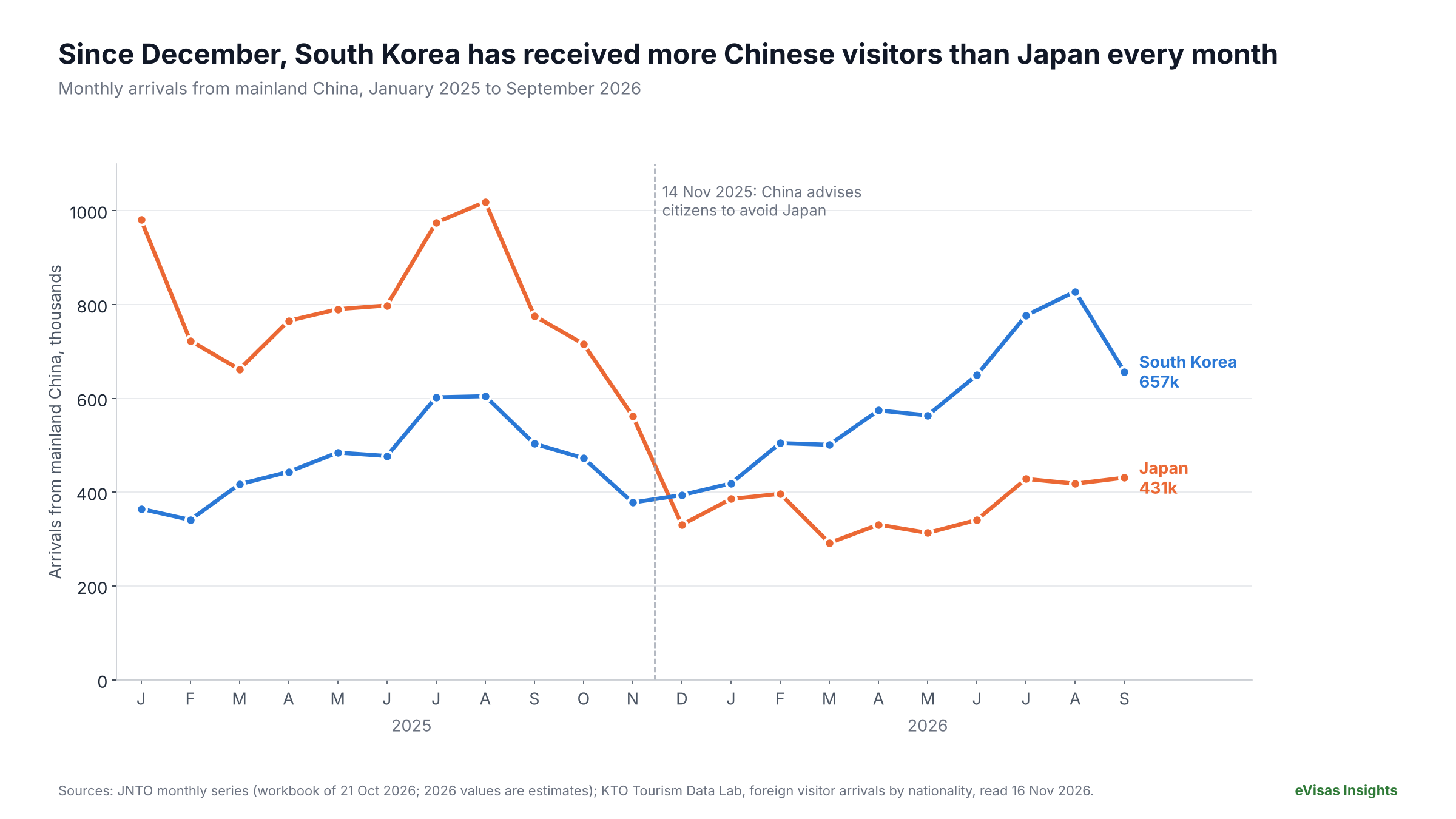
Chart 2. Monthly arrivals from mainland China to Japan and South Korea, January 2025 to September 2026. Sources: JNTO monthly series (2026 values are estimates); KTO Tourism Data Lab.
The two lines tell the story. Through most of 2025 Japan received between one and a half and nearly three times as many Chinese visitors as Korea each month: 1,018,747 in August 2025 against Korea’s 604,618. Japan’s line falls off a cliff in December 2025, the first full month after the advisory, to 330,435. Korea’s line crosses it that month, at 393,834, and keeps rising. In August 2026 Korea received 827,704 Chinese visitors, Japan 418,000.
JNTO’s own monthly commentary gives the reasons in plain terms: the Chinese government’s advice to avoid travel to Japan, and flight reductions on routes between the two countries.
Two cautions keep this honest. First, Korea’s rise did not start with the advisory. Chinese arrivals to Korea were already running about 20% above the previous year from mid-2025, so 2026 is an acceleration, not a new trend. Second, Japan itself is barely dented overall. Total arrivals for January to September 2026 were 30,730,200, down 2.9%, and still 26% above the same months of 2019, because Korean, Taiwanese and American visitors set records.
China’s National Immigration Administration confirms the reordering from the other side of the border. In the third quarter of 2026, mainland residents made 48.5 million exits, up 7.5%. After Hong Kong and Macao, the top destinations in order were South Korea, Vietnam, Thailand and Japan. Japan ranked sixth.
Where the Chinese visitors went
If 4.2 million Chinese trips to Japan disappeared, the obvious question is how many reappeared elsewhere.
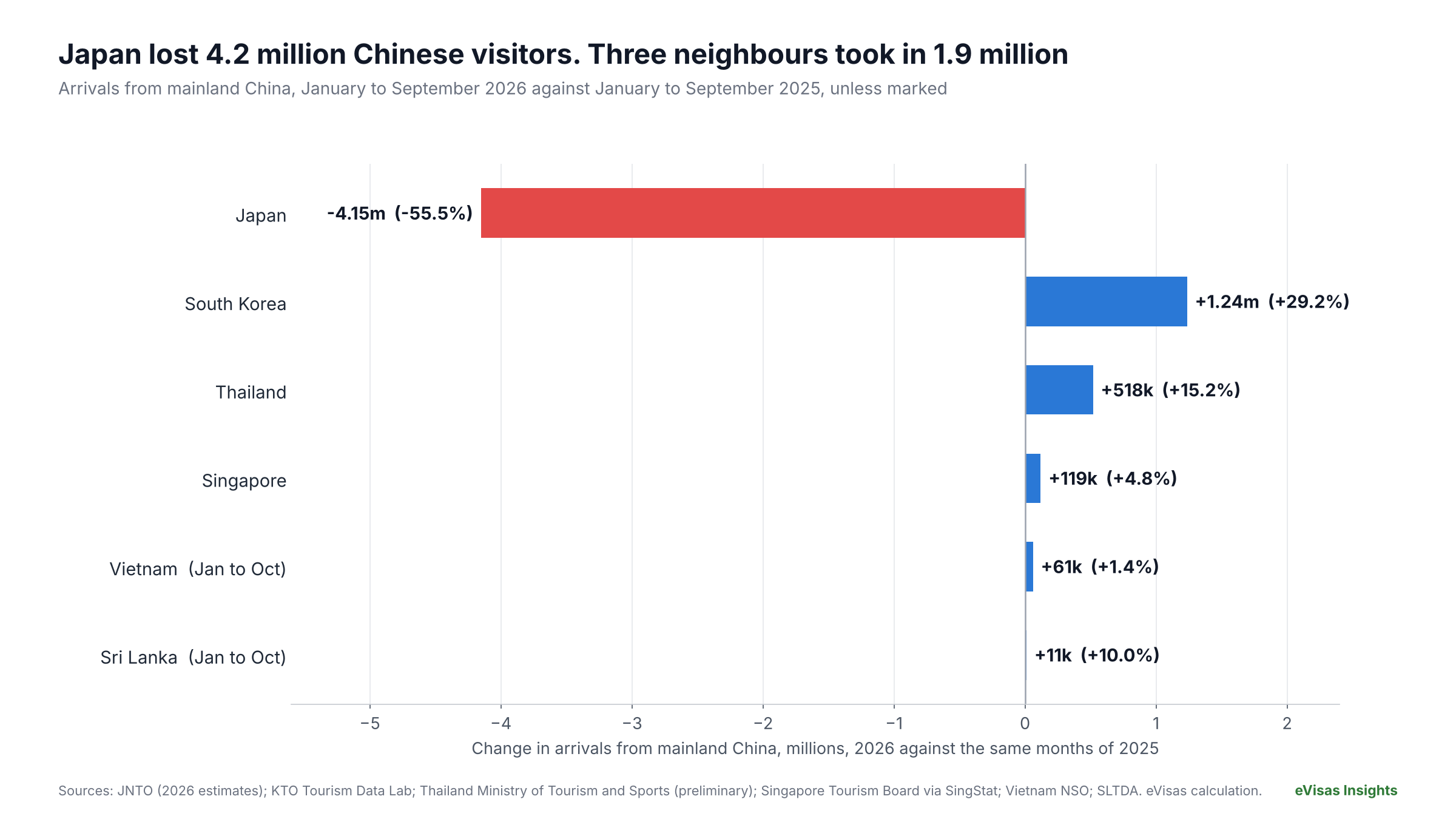
Chart 1. Change in arrivals from mainland China, 2026 against the same months of 2025. January to September, except Vietnam and Sri Lanka (January to October). Sources: JNTO; KTO Tourism Data Lab; Thailand Ministry of Tourism and Sports; Singapore Tourism Board via SingStat; Vietnam NSO; SLTDA. eVisas calculation.
Table 1. Arrivals from mainland China by destination. Japan’s 2026 figures are JNTO estimates; Vietnam’s 2025 value is derived from NSO’s published growth rate. Sources as Chart 1.
Korea, Thailand and Singapore report the same nine months, so their gains can be added: 1.87 million, or 45% of Japan’s loss. Korea alone accounts for 30% of it.
The published figures do not show where the remaining 2.3 million went. Some will have travelled to Hong Kong and Macao, which top China’s outbound list; some to destinations outside this set; some will have stayed at home. We do not guess.
Thailand’s gain deserves a footnote. Chinese arrivals there rose 15.2% in January to September 2026, the first growth after a 33.6% collapse in 2025. But in January to October 2026 Thailand still received only about 45% of its Chinese visitors of the same months of 2019. Thailand is recovering Chinese demand, not replacing Japan.
The other travellers on the move
The Chinese shift is the largest in absolute numbers, but it is one of several. Chart 3 lays out every source market and destination pair in our data.
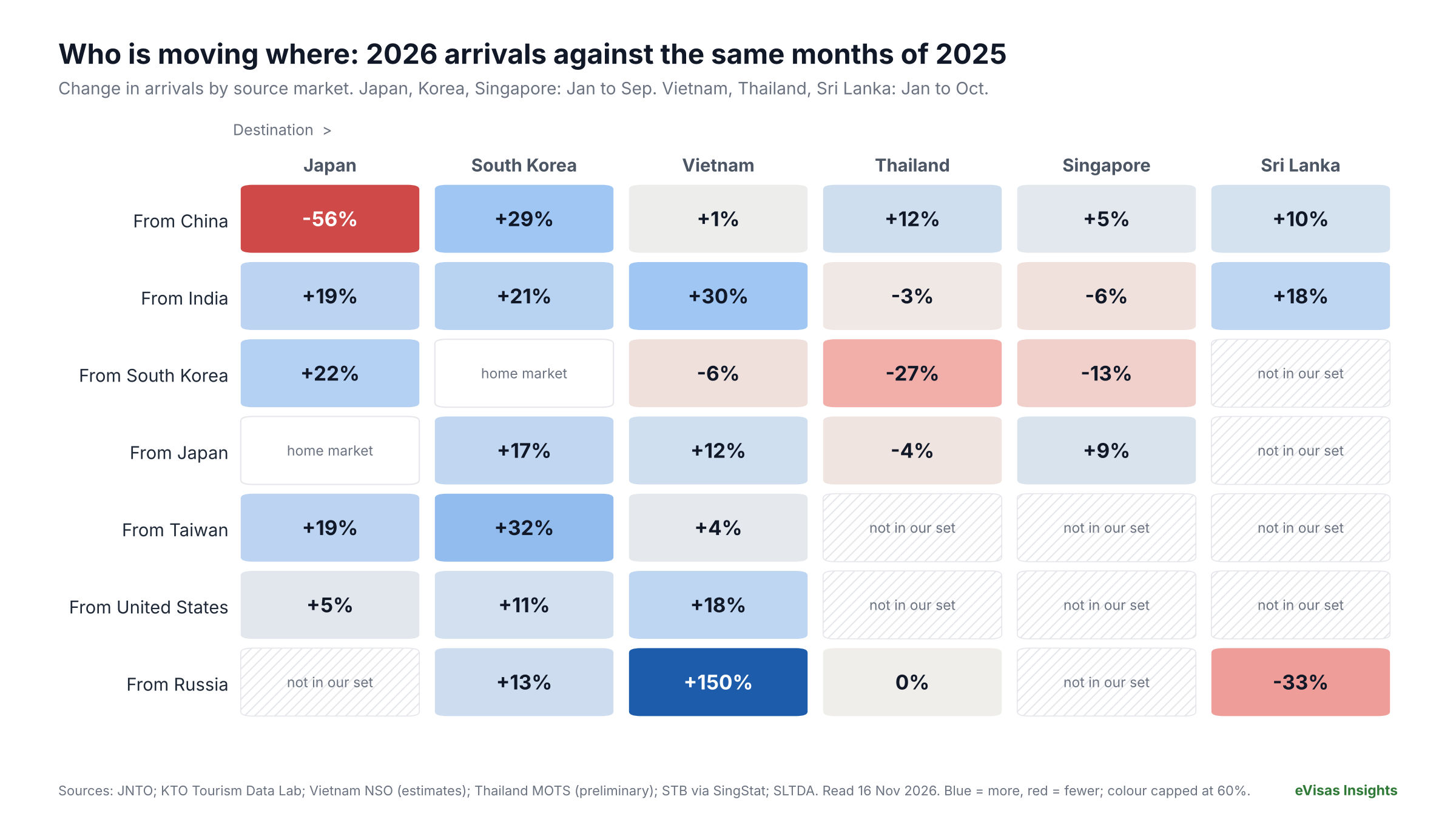
Chart 3. Change in arrivals by source market and destination, 2026 year to date against the same period of 2025. Japan, South Korea and Singapore: January to September. Vietnam, Thailand and Sri Lanka: January to October. Blank cells are pairs a destination did not publish in the tables we read. Sources: JNTO; KTO Tourism Data Lab; Vietnam NSO; Thailand MOTS; STB via SingStat; SLTDA.
Read across the rows and four patterns stand out.
Indian travellers are spreading out. India’s arrivals rose in four of the six destinations and fell in the two most familiar ones, Thailand and Singapore.
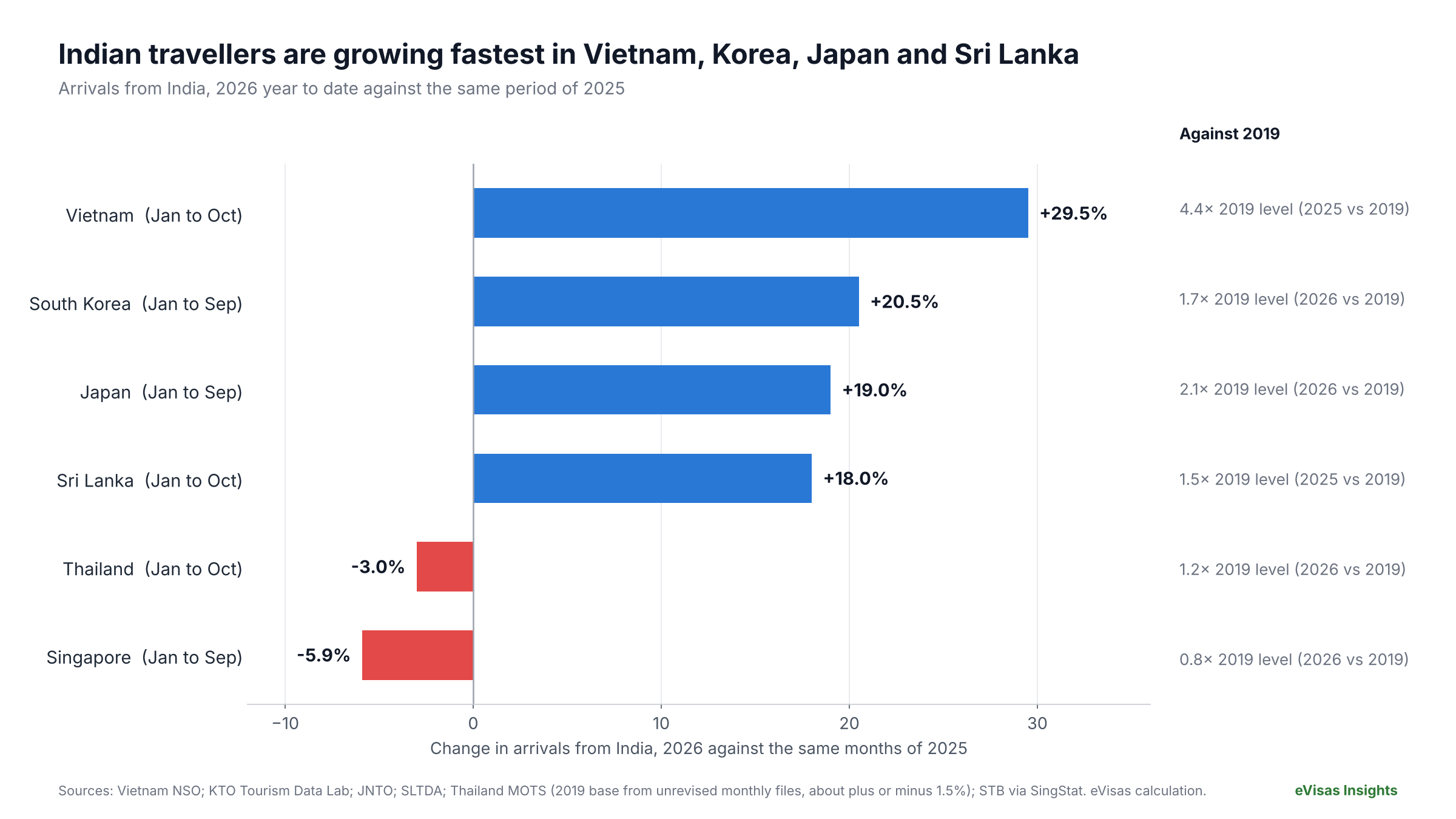
Chart 4. Change in arrivals from India, 2026 year to date against the same period of 2025, with each destination’s level against 2019. Sources: Vietnam NSO; KTO Tourism Data Lab; JNTO; SLTDA; Thailand MOTS; STB via SingStat. eVisas calculation.
Vietnam is the standout. It received 168,998 Indian visitors in 2019 and 746,480 in 2025, about 4.4 times as many, and January to October 2026 is up a further 29.5%, to 744,567. Japan’s Indian arrivals in January to September 2026 were more than double the same months of 2019. India is now Sri Lanka’s largest market by a wide margin: 499,625 arrivals in January to October 2026, about 27% of the total. Singapore is the exception that proves the rule: Indian arrivals there are 19% below 2019.
Korean travellers are concentrating on Japan. Korean arrivals in Japan reached 8,262,700 in January to September 2026, up 21.6% and 67% above the same months of 2019. Over the same period Korean arrivals fell in every Southeast Asian destination in our set.
Taiwanese travellers are heading north. Arrivals from Taiwan rose 32.4% in South Korea and 19.1% in Japan, against 3.9% in Vietnam.
Russian travellers have shifted to Vietnam. Russian arrivals to Vietnam rose from about 502,000 in January to October 2025 to 1,254,174 in the same months of 2026. Over the same period they fell 32.8% in Sri Lanka and were flat in Thailand.
The Gulf markets, which this calendar slot also targeted, are missing from the chart for a simple reason: none of these six destinations publishes Gulf arrivals in the monthly tables we read. The available signal is indirect. IATA reported traffic on the Middle East to Asia corridor down 8.8% in September 2026, and UN Tourism attributed a sharp fall in South Asian arrivals in March 2026 to disruption at Middle Eastern air hubs.
What the air routes say
Arrivals data can be revised and counted differently from country to country. Passenger counts on specific air routes are an independent check.
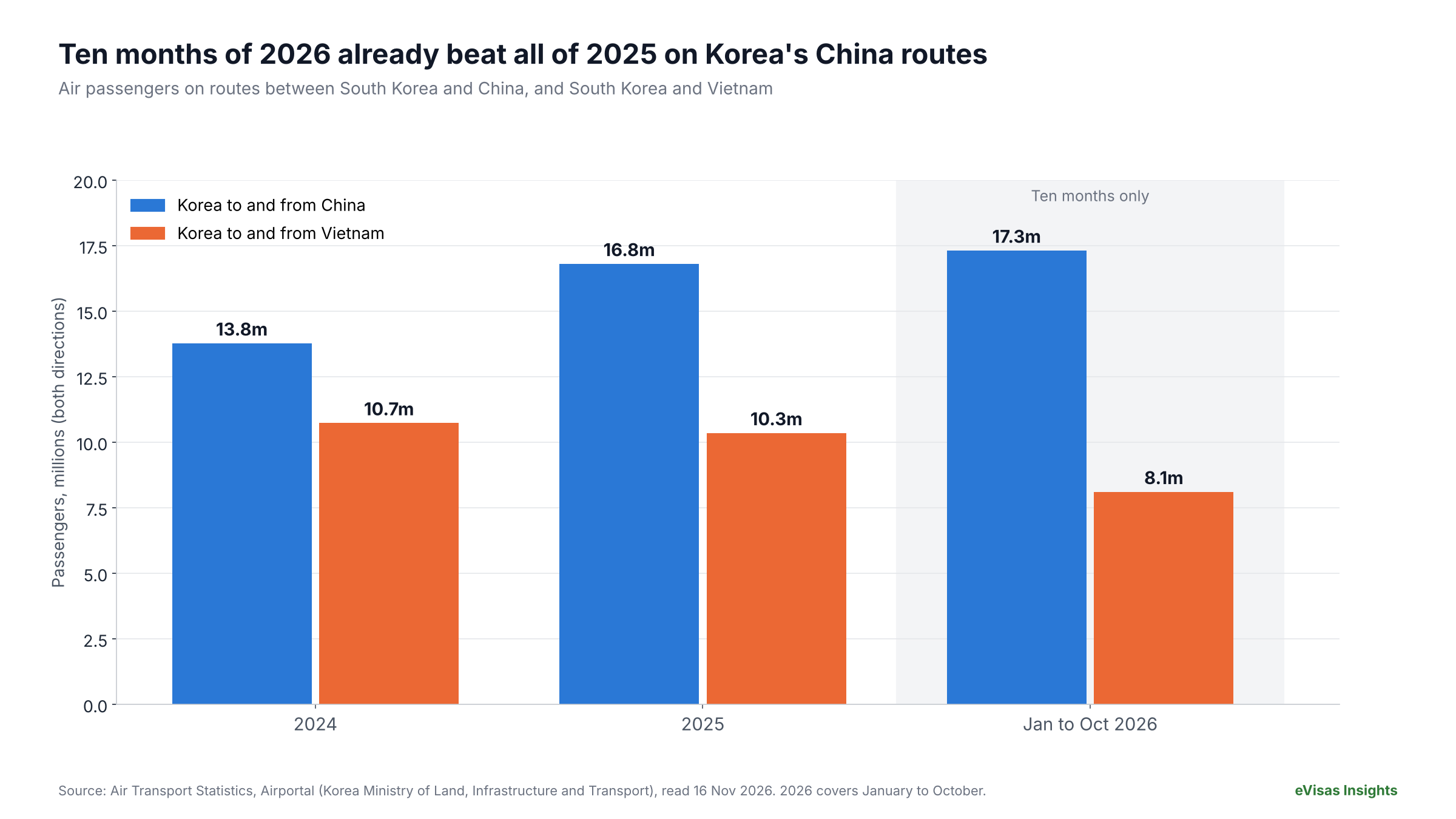
Chart 5. Air passengers on routes between South Korea and China, and South Korea and Vietnam, both directions. Source: Airportal, Korea Ministry of Land, Infrastructure and Transport, read 16 November 2026.
Korea’s government aviation statistics portal counted 17,312,160 passengers on routes between Korea and China in January to October 2026, against 16,803,863 in the whole of 2025 and 13,772,415 in 2024. Ten months of 2026 have already passed the full previous year. Routes between Korea and Vietnam went the other way: 8,103,695 passengers in ten months, against 10,349,329 in all of 2025. That matches the fall in Korean arrivals to Vietnam.
The wider air data is a useful reminder that this is a reshuffle, not a boom. IATA reported that traffic on routes within Asia fell 2.0% in August 2026 and 0.9% in September, with capacity down for four months in a row by August. Travellers in the region are not flying more overall. They are flying to different places.
Destination by destination, and what each requires
For a traveller choosing a destination for early 2027, the data is the first half of the decision. The second half is the entry document, which differs by passport and has to be arranged before departure. The notes below cover what travellers from the largest growing markets need, checked on government pages on 16 November 2026. Requirements for other passports differ; our nationality pages list them.
South Korea: the main beneficiary
What the numbers say. Total arrivals of 17,110,477 in January to September 2026, up 21.5% and 32% above the same months of 2019. Growth from every major market: China up 29.2%, Taiwan up 32.4%, India up 20.5%, Japan up 16.9%. UN Tourism called Korea’s first-half performance remarkable.
Before you go. Indian and Chinese tourists need a Korean visa before travel. Korea’s electronic travel authorisation, the K-ETA, is for nationalities that can enter without a visa, and travellers from those countries should check whether it applies to them before booking. Our South Korea page covers the K-ETA.
Japan: still large, rebalanced
What the numbers say. Total arrivals of 30,730,200 in January to September 2026, down 2.9% on 2025 but 26% above 2019. Chinese arrivals fell 55.5%; Korean (up 21.6%), Taiwanese (up 19.1%) and Indian (up 19.0%) arrivals rose. For travellers from those growing markets, fewer Chinese tour groups is a change in the mix, not a sign that Japan has emptied.
Before you go. Indian and Chinese passport holders need a visa for Japan. For residents of some countries it can be issued electronically as a Japan eVisa: a single-entry tourist visa, with stays of up to 90 days (15 or 30 days for Chinese nationals living in China), and the online visa issuance notice must be shown on arrival. Our Japan page sets out who qualifies.
Vietnam: India’s breakout destination
What the numbers say. International arrivals of 19,535,396 in January to October 2026, up 13.8%, on NSO estimates. Growth was led by Russia (up 150.0%), the Philippines (up 52.4%), Cambodia (up 43.2%) and India (up 29.5%). Chinese arrivals were flat and Korean arrivals fell 6.3%.
Before you go. Indian and Chinese visitors need an e-visa, issued for stays of up to 90 days with single or multiple entry, before they travel. Our Vietnam page explains the application.
Thailand: Chinese demand returning, slowly
What the numbers say. Total arrivals of 25,464,306 in January to October 2026, down 4.6% on preliminary figures. Chinese arrivals rose 12.4% but remain far below 2019. Arrivals fell from Malaysia (down 16.3%), South Korea (down 26.9%) and India (down 3.0%).
Before you go. Every foreign arrival must complete the Thailand Digital Arrival Card online within three days before arriving, on the Immigration Bureau’s own portal. Thailand’s Tourist eVisa allows stays of up to 60 days per entry; whether you need one depends on your passport and the length of your stay. Our Thailand page lists both.
Singapore: steady, still below 2019
What the numbers say. Total arrivals of 12,652,341 in January to September 2026, down 1.7% and at 88% of the 2019 level. Chinese arrivals rose 4.8% and Japanese 8.6%; Indian arrivals fell 5.9% and Korean 13.1%.
Before you go. Indian visitors need a Singapore visa before travel. Every foreign visitor must also submit the SG Arrival Card to Singapore’s Immigration and Checkpoints Authority before arriving. Our Singapore page covers the visa.
Sri Lanka: India’s nearest growth market
What the numbers say. Total arrivals of 1,862,304 in January to October 2026, down 1.5%. Indian arrivals rose 18.0% and Chinese 10.0%; Russian arrivals fell 32.8% and German 9.8%.
Before you go. Every visitor, including travellers from India and China, must obtain an Electronic Travel Authorization (ETA) before arrival. It covers a stay of 30 days with double entry. Our Sri Lanka page explains it.
Table 2. Fastest-growing source markets (from Chart 3) and the pre-travel document, checked on government pages on 16 November 2026. Requirements for other passports differ.
Planning notes for Q1 2027
Expect crowds where the travellers went. South Korea’s arrivals are running 32% above 2019, and August 2026 brought 2.25 million foreign visitors, its highest monthly total since at least 2019. Lunar New Year falls on 6 February 2027, and Seoul and Busan in that fortnight will feel it.
Expect a different Japan. With Chinese arrivals at less than half of 2025 levels, the mix in Japan’s cities has changed, but total arrivals are close to last year’s record. Tokyo and Kyoto are not quiet.
Check the document for your passport, not your neighbour’s. The same destination asks different things of different travellers. An Indian traveller heading to Vietnam needs an e-visa; to Sri Lanka, an ETA; to Korea or Japan, a visa. Our nationality pages for India, China and South Korea list each requirement by destination.
Treat 2026 as a reshuffle, not a trend line. Travel advisories can be lifted and flights restored. The pattern in this article is the state of the market in autumn 2026, and we will update it as the October and November data arrives.
Methodology and limitations
Sources. Arrivals by source market come from each destination’s official publisher: the Japan National Tourism Organization (monthly workbook of 21 October 2026), the Korea Tourism Organization’s Tourism Data Lab, Thailand’s Ministry of Tourism and Sports (2026P workbook, October file), the Singapore Tourism Board via SingStat table M550001, Vietnam’s National Statistics Office (October 2026 tables), and the Sri Lanka Tourism Development Authority (October 2026 report). Air passengers come from Airportal, Korea’s government aviation statistics portal, and IATA’s monthly passenger releases. China’s outbound ranking comes from the National Immigration Administration’s Q3 2026 release. Regional context comes from UN Tourism’s September 2026 World Tourism Barometer. Entry requirements were read on embassy, immigration and foreign ministry pages.
Calculations. Changes compare 2026 with the same months of 2025 in each destination’s own data. Gains and losses are added only across destinations that report the same months (Japan, Korea, Thailand and Singapore for January to September). Comparisons with 2019 use the same months of 2019 where available, and the 2019 full year otherwise, which is stated each time.
Limitations. Periods differ: Japan, South Korea and Singapore to September; Vietnam, Thailand and Sri Lanka to October. Japan’s 2026 figures are JNTO estimates; Vietnam’s are NSO estimates, and Vietnam’s 2025 comparison values are derived from NSO’s growth rates. Thailand’s 2026 data is preliminary, and its 2019 year-to-date base comes from unrevised monthly values (accurate to about 1.5%). Destinations count differently: Japan and Korea count by nationality, Singapore and Sri Lanka by country of residence. Korea’s Airportal counts passengers in both directions on each route, including residents of Korea. No figure in this article shows why a traveller chose a destination; where we give a reason, it is the publisher’s own.
Dataset. The figures behind every chart are published with this article as a CSV file under a Creative Commons Attribution 4.0 licence.
Frequently asked questions
Mostly to South Korea. In January to September 2026 Korea’s Chinese arrivals rose 29.2% to 5.47 million while Japan’s fell 55.5% to 3.34 million. Thailand (up 15.2%) and Singapore (up 4.8%) also gained, but together the three took in only about 45% of Japan’s loss.
Conclusion
The travellers Asia lost in 2026 did not vanish from the map. They moved. Chinese travellers left Japan, and South Korea took the largest share of them. Indian travellers moved beyond Thailand and Singapore towards Vietnam, Korea, Japan and Sri Lanka. Korean travellers chose Japan over Southeast Asia, and Russian travellers chose Vietnam.
None of these moves restored the region to its 2019 size, and the air data shows travellers flying no more than before, just to different places. For anyone planning the first months of 2027, the useful questions are where everyone else is going, and what your own passport needs to get you there.