Georgia Closes Its Digital-Nomad Loophole: Work Permits Now Required
 Elena DarziSeptember 23, 20263 min read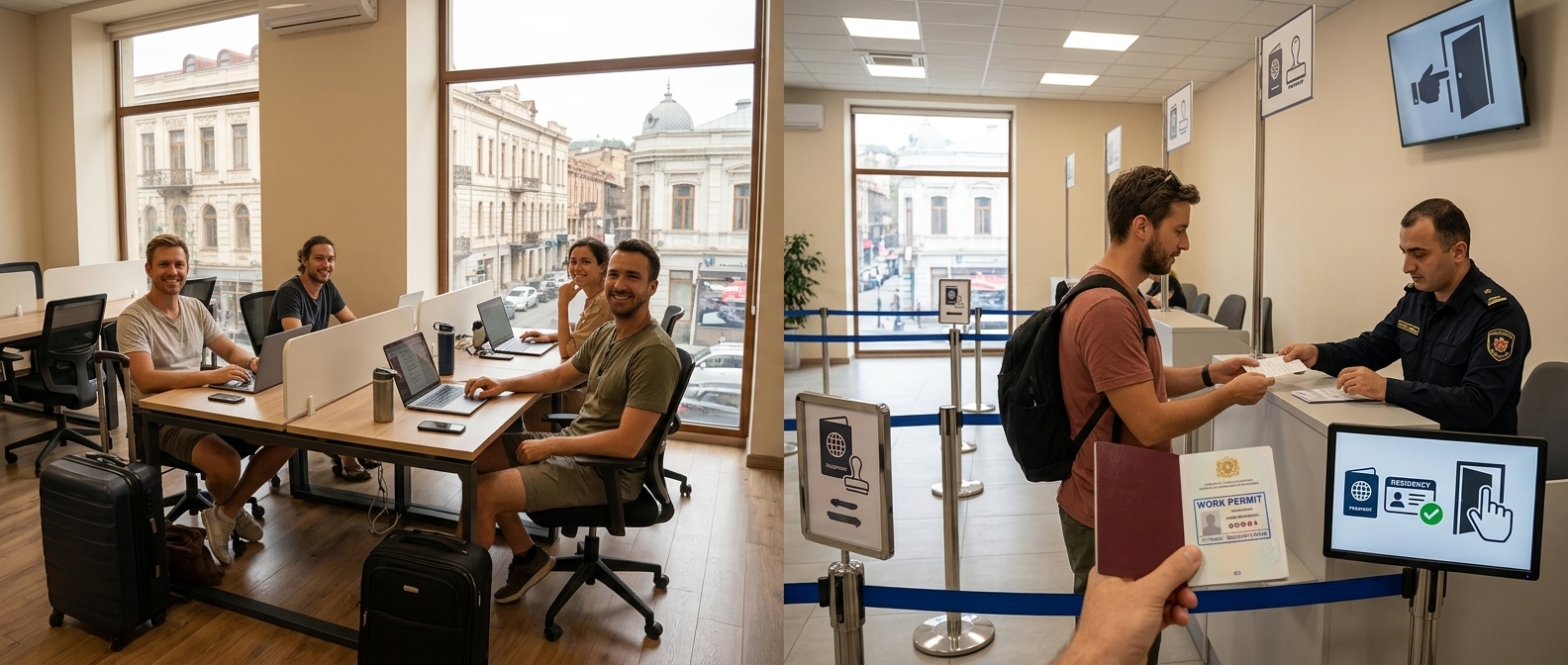
For years Georgia was among the easiest countries in the world for a remote worker to base themselves. That ended on 1 March 2026.
What Georgia used to offer
An unusually generous combination: visa-free entry for citizens of a long list of countries, with a permitted stay of up to one year (not 90 days, not six months, a full year), and no requirement to hold any kind of work authorisation for remote work performed for an employer outside Georgia.
For a remote worker, that was close to ideal. Low cost of living, a year of legal presence, and no permit to obtain. Tbilisi and Batumi became established bases on the strength of it.
What changed on 1 March 2026
Foreign nationals working in Georgia must now obtain an annual work permit. The requirement explicitly extends to remote work performed for a foreign employer, and to running a business.
The permit is tied to a specific position and a specific employer. It is not a general authorisation to work in the country.
Why the tie to a specific employer is the hard part
This is the structural problem for remote workers, and it goes beyond paperwork.
A permit tied to a named position and a named employer assumes a conventional employment relationship. A freelancer with multiple clients, a contractor whose engagements rotate, or a founder running their own company abroad does not fit that shape neatly.
Nor does a foreign employer with no Georgian presence necessarily have the appetite or the legal standing to sponsor a permit in a country where it does not operate.
The framework was not designed with remote workers in mind, and remote workers are the group it now catches.
The insurance requirement
Separately, visa-free visitors must maintain health insurance covering at least 30,000 Georgian Lari for the entire duration of their stay.
For someone staying a full year, that is a continuous obligation, not a one-off purchase at the border. Travel insurance sold for a two-week holiday will not satisfy a twelve-month requirement, and the coverage level is specified rather than left to judgement.
Does this affect ordinary tourists?
The work permit requirement does not, provided you are genuinely not working. A holiday remains a holiday.
The insurance requirement applies more broadly to visa-free visitors and should be checked by anyone planning an extended stay.
The grey area, answering work emails on holiday, is not what the rule is aimed at. Basing yourself in Georgia and working from there is.
What should affected remote workers do?
Be realistic about which category you are in. Someone employed by a single foreign employer willing to engage with the process has a path. A freelancer with rotating clients may not, and should establish that early rather than assuming it will resolve.
Do not simply continue as before. Working without the required permit is now working without authorisation, with the consequences that carries, including for your future ability to enter.
Sort the insurance regardless. It applies to visa-free stays generally, not only to workers.
Where else?
Several countries have moved in the opposite direction over the same period, building purpose-designed routes for remote workers rather than leaving them in a grey zone. Those routes generally involve an income threshold, documented remote employment or client income, and health insurance: more paperwork than Georgia used to demand, but a defined status rather than an ambiguous one.
For anyone whose Georgian arrangement no longer works, the practical question is whether a country with a designed route is a better base than one where you are relying on the absence of a rule.
The broader lesson
Georgia's old arrangement was not a policy aimed at remote workers. It was a generous visa-free regime that remote workers made use of. Arrangements of that kind can close without warning, because nothing was ever promised.
Anyone building a life around the absence of a requirement should assume the requirement can arrive.
Verified against UK Foreign, Commonwealth and Development Office entry requirement guidance for Georgia, current as at 2026.