Schengen Visa Refusal Rates by Nationality: What the Official 2024 Data Shows
 Luca BenedettiSeptember 17, 20264 min read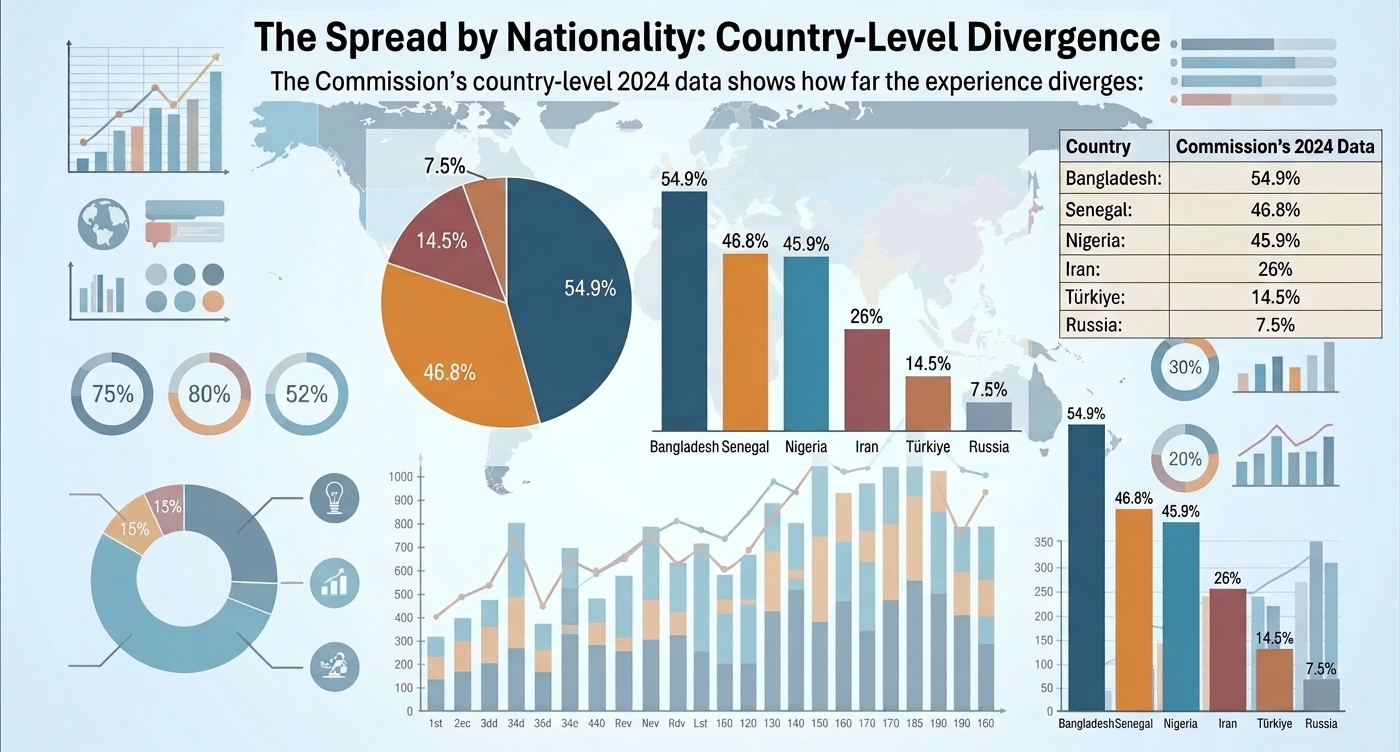
Refusal rates for Schengen visas vary enormously depending on the passport you hold. The European Commission publishes the figures, and the spread between nationalities is wider than most applicants realise.
The headline numbers for 2024
There were 11.7 million Schengen visa applications in 2024, up 13.6% on the previous year.
9.7 million visas were issued, up 14.1%.
The global refusal rate was 14.8%, down from 16% in 2023.
China led application volume with 1.78 million applications.
The global picture, then, is one of growth and modest improvement. That global figure tells an individual applicant almost nothing.
The spread by nationality
The Commission's country-level 2024 data shows how far the experience diverges:
Bangladesh: 54.9%
Senegal: 46.8%
Nigeria: 45.9%
Iran: 26%
Türkiye: 14.5%
Russia: 7.5%
An applicant from Bangladesh faced a better-than-even chance of refusal. An applicant from Russia faced roughly one in thirteen. Same visa, same rules, same consulates.
What drives the difference?
Not, in the main, the individual applicant's honesty or intentions. The dominant factors are structural.
Consulates assess the risk that an applicant will not return, and they assess it against patterns, not just against your file. Countries with high historical overstay or asylum-claim rates attract more sceptical assessment of every application from that country.
Documentary norms differ. Evidence that is routine and easily produced in one country (employment contracts, property registers, verifiable bank histories) can be harder to produce in another, even for an applicant whose circumstances are genuinely strong.
Consular capacity varies. Where demand overwhelms appointment availability, the process itself becomes a filter.
What this means if you are from a high-refusal country
Two things, and they pull in different directions.
The first is that the base rate is not a prediction about you. A 45% national refusal rate does not mean you have a 45% chance. It aggregates a population that includes weak and speculative applications alongside strong ones.
The second is that you will be assessed more sceptically than an applicant from a low-refusal country presenting an identical file. That is the practical reality the data describes, and pretending otherwise does applicants no favours.
The response to both is the same: the burden of demonstrating your circumstances is higher, so the file has to be stronger.
Where refusals actually come from
Across the Schengen area, the recurring grounds are consistent: the purpose and conditions of the stay were not established; the applicant did not demonstrate sufficient means; the applicant did not demonstrate an intention to leave before the visa expires; the supporting documentation was unreliable or inconsistent.
Read that list carefully. Three of the four are about what the file demonstrates, not about what is true. An applicant with a stable job, a family and every intention of returning can be refused because none of that was evidenced in a form the consulate accepts.
Practical implications
Consistency across the file matters more than the strength of any single document. Dates, amounts, employer names and addresses that do not match between documents are read as unreliability.
Financial evidence should show a pattern, not a moment. A balance that appeared last week reads differently from a six-month history.
Ties to the home country need to be demonstrated in documents, not asserted in a cover letter.
And the itinerary should be coherent. A booking pattern that does not make sense as a trip invites questions about whether the stated purpose is the real one.
A comparison point
The United States publishes equivalent data. The State Department's annual Report of the Visa Office includes refusal grounds, and a separate Adjusted Visa Refusal Rate dataset by nationality is published and used in Visa Waiver Program eligibility assessments.
Both datasets tell the same story: refusal risk is heavily nationality-dependent, and it is published openly by the authorities themselves.
What we can and cannot say about improving your odds
No service can guarantee an approval, and nobody can quantify how much any preparation improves a specific application's chances. Any figure offered for that is invented.
What is demonstrably true is that a large share of refusals turn on documentation that was incomplete, inconsistent or insufficient, not on the applicant's underlying eligibility. That is the part that preparation addresses.
Verified against European Commission (Migration and Home Affairs) Schengen visa statistics for 2024, published May 2025, and US Department of State visa statistics publications.